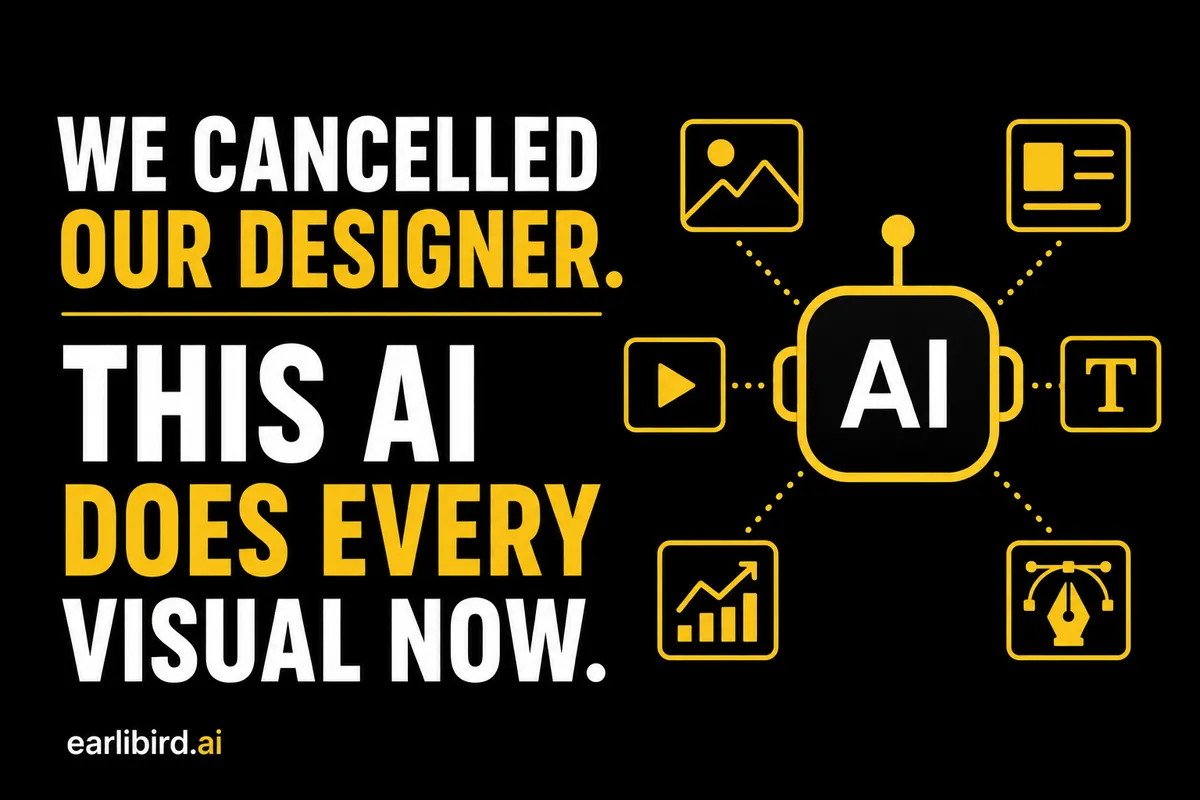
How We Cancelled Our Designer and Replaced Them with Two AI Skills
HOW WE CANCELLED OUR DESIGNER AND REPLACED THEM WITH TWO AI SKILLS
Most businesses pay $3,000 a month or more on design work.
We pay zero.
Not because we cut corners, because we built two AI skills inside Claude that produce every single visual you see on our channel and our socials.
Thumbnails.
Video graphics.
LinkedIn carousels.
Sales decks.
Case study PDFs.
Lead magnets.
Blog hero images.
Internal training slides.
Same brand, same look, every time.
This article walks through why design is a revenue problem (not a cosmetic one), why most AI design tools fall short on their own, and how skills change the equation.
WHY DESIGN IS A REVENUE PROBLEM
Design is not the goal.
Revenue is.
Design is one of the things that drives revenue.
The research is consistent on this:
Brand-consistent imagery lifts revenue 23 to 33% (Lucid Press)
Good designers cost $80 to $150 per hour, with sales decks running $2K to $5K each (IbisWorld)
Sales reps spend 40% of their week building presentations instead of selling (CMO Council)
If you are a business owner, you want more sales, more leads, more traffic, and more trust.
To get those things, you need a lot of visuals: video sales letters, pitch decks, case study presentations, social posts, website images, lead magnets, and more.
The block is the same for almost every business.
Either you hire a designer (slow, expensive, queue-bound), or you spend hours yourself in Canva or a similar tool.
Either way, design becomes a bottleneck.
And the bottleneck costs revenue.
WHY AI TOOLS ALONE ARE NOT THE ANSWER
Most people, when they hear "AI design", reach straight for a tool.
Nano Banana, Midjourney, ChatGPT Image Gen, Canva AI.
They are all useful, we use a lot of them.
But on their own they share the same problem: the outputs are rarely on-brand, and the consistency is not there.
Run the same prompt three times in Nano Banana and you get three different results.
Different colours.
Different fonts.
Different styles.
Nothing reproducible.
Which means three things:
1. You cannot scale it. Every output is a one-off.
2. You cannot hand it to a teammate. They will get different results.
3. You cannot trust it for client delivery. You never know what is coming back.
The tool is not the problem.
The wrapper around the tool is the problem.
WHAT A SKILL ACTUALLY IS
A skill, when it comes to AI, is basically an SOP your AI executes consistently.
You set up the brand profile and the rules once: colours, fonts, layout patterns, design profiles, example outputs you like. Then every time the skill runs, the outputs match.
Regardless of who pressed the button.
We have about 12 different design profiles inside Earlibird (Memphis, classic, broad, punch, canonical, and a few others). The skill picks the right profile for the job, applies the brand rules, and produces a deck in 3 to 5 minutes.
That is the difference between a prompt and a skill.
A prompt is a note.
A skill is an asset.
WHAT THE WORKFLOW LOOKS LIKE
Here is how it actually runs.
I open Claude, paste in (or reference) the outline of the video, post, or presentation.
I run the presentation skill.
It plans the slides, asks a couple of clarifying questions, and 3 to 5 minutes later I have a full PowerPoint.
The skill outputs as PowerPoint, not as flat images.
That is critical.
Everything is editable in Google Slides, PowerPoint, or Keynote.
If I want to tweak a stat, swap a heading, or move a chart, I do it in 10 seconds in Slides.
No re-running, no re-prompting.
If something is off (spacing, an icon, a misaligned element), I talk to the skill like a person.
"Tighten the spacing on slide 3."
"Swap that icon for one related to money."
It makes the adjustment.
Done.
It used to take me 18 hours to build a single workshop deck.
Now it is a matter of minutes.
If you would rather walk through your actual numbers on a call (where design and content production are leaking time and money in your business, and what an AI revenue system would look like for you), book an AI Review Call here: earlibird.ai/schedule-ai-review-call
WHERE THIS FITS IN A BUSINESS
The same skill applies across the whole business, not just marketing.
Content and video: YouTube thumbnails, LinkedIn carousels, blog hero images, social posts.
Sales and conversion: video sales letters, pitch decks, proposals, comparison slides.
Client delivery: case study PDFs, lead magnets, presentation decks, onboarding documents.
Internal use: SOPs, course slides, webinar decks, training material, team onboarding.
That is one skill removing recurring cost across four different areas of the business.
The bigger the business, the bigger the saving compounds.
WHY THIS MATTERS BEYOND DESIGN
The design example is the easy one to point at because the cost saving is obvious.
But the bigger lesson applies to every area of AI work.
The reason AI projects in most businesses do not compound is not because the tools are bad.
It is because there is no skill layer.
Prompts you cannot hand to anyone else are not assets, they are notes.
The same person has to write the prompt every time, with slightly different results each time, and the work cannot scale.
Skills lock the work in.
They make outputs predictable, repeatable, and team-shareable.
That is what turns AI from a personal productivity tool into a business asset.
HOW TO BUILD YOUR FIRST DESIGN SKILL
Pick one repeatable design task in your business.
Thumbnails, sales decks, social tiles, anything you produce more than once a month.
Document your brand the way you would brief a new designer: colours (hex codes), fonts, three or four layout patterns, and three example outputs you actually like.
Drop all of that into Claude or ChatGPT as a custom skill (or a Project, or a Custom GPT).
Run it the next time the task comes up.
If the output is on-brand on the first or second try, you have just removed a recurring cost from your business.
WHAT TO DO NEXT
If you want this presentation skill plus 55+ others, weekly live calls with me and the team, and the full skill library, Earlibird Labs is open.
Labs is for business owners, employees, and operators using AI for real work.
It is not for agency bros and it is not for ChatGPT tip collectors.
Every week we are adding new skills.
You get direct access to me and the team on the live calls to ask anything you want about how to apply AI in your business.
Join Earlibird Labs here: link.earlibird.ai/labs
Talk soon,
Chris


