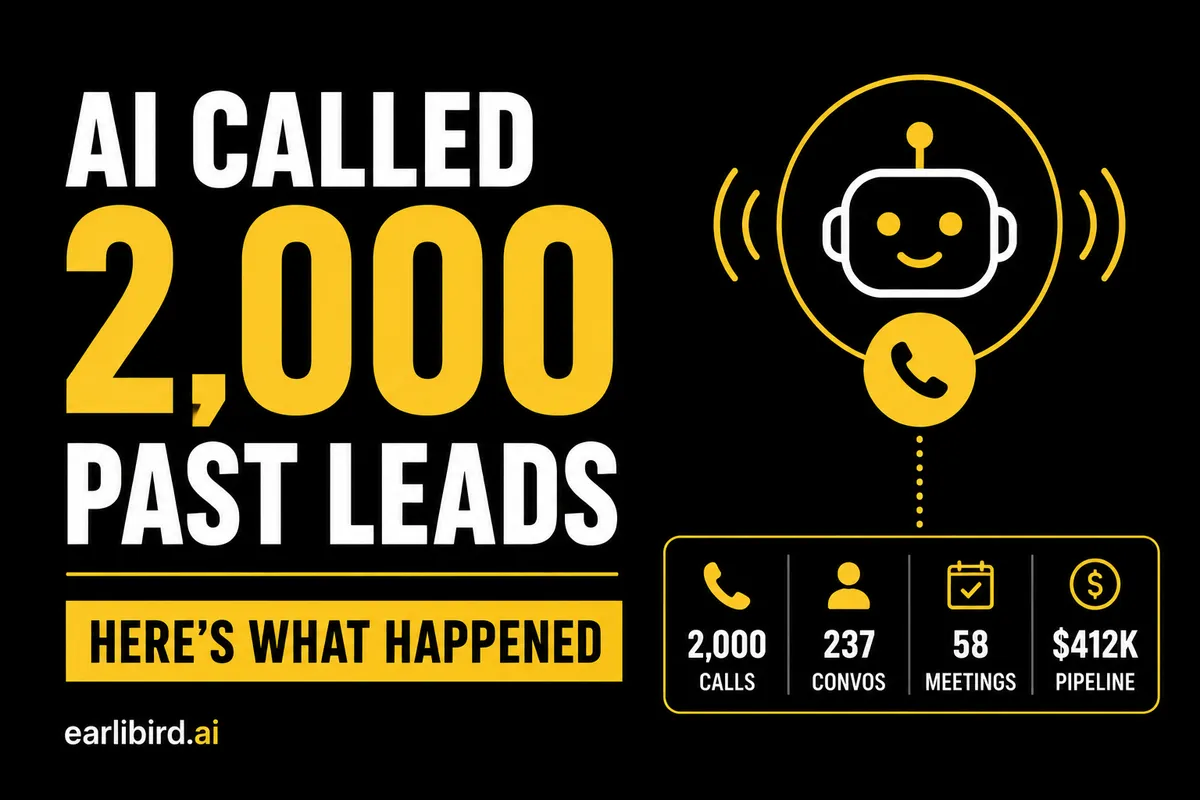
AI Called 2,000 Past Leads Heres What Happened
AI CALLED 2,000 PAST LEADS IN 40 MINUTES. HERE'S WHAT HAPPENED.
We took a list of 2,000 forgotten leads.
Called every single one of them in 40 minutes using AI.
Booked $4.6 million in pipeline from people the client had written off.
The leads had inquired about a franchise opportunity 18-24 months earlier.
They didn't go ahead at the time.
The client had moved on.
The names sat in the CRM doing nothing for a year and a half.
This was the first campaign we ran for them on the AI Revenue Recovery System.
Here's the breakdown, then the five lessons that apply whether you use AI, a human team, or you're doing it yourself.
THE NUMBERS
2,000 calls placed in 40 minutes
700 said "no longer interested"
340 said "still interested, but not the right time"
92 booked appointments on the call (each worth $50K)
25 additional callers wanted to book but couldn't (calendar full)
Total pipeline from one campaign: $4.6M.
The 340 "still interested, not right now" leads represent another $17M at full conversion.
Even at 1% they're worth $170K.
LESSON 1: TIMING IS THE BIGGEST HIDDEN OBJECTION
Most owners treat "not right now" as a no.
It isn't.
Across 60+ implementations, "not right now" is consistently the biggest reactivation revenue category in any database with more than a year of history.
The mistake isn't asking the question.
The mistake is the follow-up that never happens.
You log a note in the CRM that says "follow up in 7 months."
Three quarters later, the note doesn't surface, the rep has moved on, and the warm lead is cold again.
The fix is structural.
The system schedules its own follow-up at the exact time the prospect nominated, with the full context of the original conversation.
"Last time we spoke, you said you needed to sell your other business before joining this one.
How's that going?"
That's not a chatbot.
That's a system handling the part of the sales cycle most teams quietly fail at.
LESSON 2: SMALL BATCHES BEAT BIG LISTS
The 2,000-call number sounds great.
But the campaign exposed a sales team that wasn't ready for 92 appointments in a fortnight.
We lost the overflow 25 bookings because the calendar was full.
We lost some of the booked 92 to weaker follow-up because the team was buried.
The fix: smaller batches on a regular cadence.
Same total volume across the year, smoother delivery, better conversion.
If your sales team can handle 30-50 calls per week, run 30-50 per week.
Not 2,000 in one hit.
This isn't an AI-specific lesson.
It applies to any reactivation effort.
The constraint is always downstream capacity, not the dial volume.
LESSON 3: GET THE NO EARLY
700 of the 2,000 told us they were no longer interested.
Most owners look at that and flinch.
Don't.
The fast no is the most valuable signal in the campaign.
Until you get the no, you're carrying a phantom number of active leads in your head.
Your team spends time chasing them, your forecasts are inflated, your CRM looks busier than reality.
Once 700 of them say no, your team has 1,300 actual opportunities to work, not 2,000 ghosts.
In the call structure we use, the first thing we do is confirm the right person, the second thing is establish whether there's interest at all.
If there's no interest, we end the call and move on.
That's how 2,000 calls fit into 40 minutes.
LESSON 4: SOLVE CAPACITY BEFORE GENERATING DEMAND
Before you hit go on any reactivation campaign, work through this checklist:
Can your sales team handle a 20-30% spike in appointments over the next 3-4 weeks?
Are there enough open slots in the calendar?
Do you have a backup sales rep if your main person gets sick?
Can your delivery team actually fulfil if appointments convert?
If any of those is a no, fix it first.
Reactivation is one of the highest-leverage channels you've got.
Don't waste the lift on a queue you can't service.
LESSON 5: REACTIVATION IS A CHANNEL, NOT A CAMPAIGN
The 2,000-call number is the headline.
The compounding number is more important.
That same franchise client now runs the reactivation system on a monthly cadence.
As of this campaign, 80% of their appointments come from reactivation.
Not from paid ads.
Not from content.
Not from referrals.
From people already in their database, contacted at the right time with the right follow-up logic.
The compounding effect is built in.
The "call me in 6 months" leads from the first run become live opportunities by run number six.
The "yes in 9 months" leads become live by run number nine.
Each monthly cycle starts the previous cycle's deferred conversations.
Treat reactivation as a channel and it stacks the same way SEO or paid ads stack.
Treat it as a once-a-year campaign and you'll never see the compounding.
AI VS HUMANS: AN HONEST COMPARISON
A few places AI wins:
Cost per call. AI runs at roughly 24 cents per minute. A 5-minute conversation costs about $1.10 and only if the person actually picks up. A human dial costs $5-15 once you load in time, overhead, and overheads.
Hours of availability. AI runs 7am to 9pm in the prospect's time zone. Human teams are usually capped at business hours unless you pay overtime.
Parallel dialling. AI runs 50+ simultaneous conversations. Humans dial one at a time.
Callback logic. When a prospect says "call me back at 3pm," the AI books itself in and follows through automatically. Human callback execution is hit and miss and CRM-dependent.
A few places humans clearly still win:
Closing high-ticket sales. AI is not good at closing deals of $50K+ right now. Humans are.
Multi-step or sensitive deals. Complex sales with nuance and judgment belong to a human.
The right pattern is: AI handles the repetitive calls at scale to establish interest and qualify.
Then the qualified, interested prospects get handed to a human to close.
AI does the work humans don't want to do, humans do the work AI can't.
WHAT TO DO THIS WEEK
1. Pull a count of contacts in your CRM older than 6 months that never converted.
2. At a conservative 5% conversion rate and your average deal value, calculate the latent pipeline.
3. Compare it to your monthly ad spend. If reactivation pipeline beats new-lead spend, you're paying for the wrong thing.
If you want to know what a reactivation campaign would actually look like in your business with your real numbers, book a call and we'll go through it together.
Book an AI Review Call → earlibird.ai/schedule-ai-review-call
These leads are already in your system. You've already paid for them. You might as well get the value from them.


